
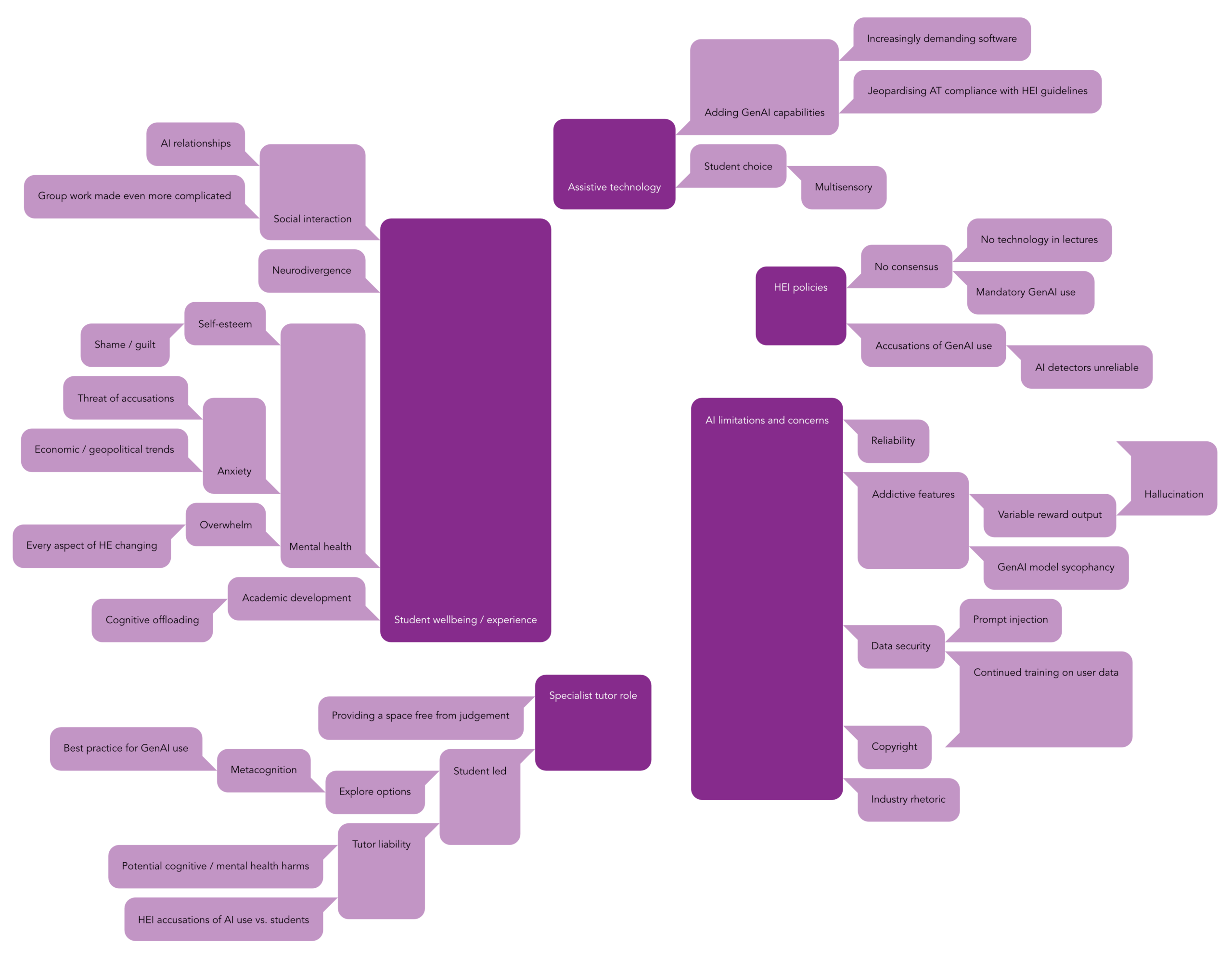
Contents
Preface
This document assumes some pre-existing familiarity with Generative Artificial Intelligence (GenAI). Readers can use these links to other key sector guidance to learn more:
JISC: https://www.jisc.ac.uk/innovation/artificial-intelligence
QAA: https://www.qaa.ac.uk/sector-resources/generative-artificial-intelligence
Legal disclaimer: Nothing in this document should be taken as legal advice.
It may be relevant to bear in mind that many more narrowly focused assistive technologies (e.g. text-to-speech narration software, speech-to-text dictation and transcription software, as well as spellcheckers) have long utilized underlying machine learning principles. Where concerns regarding assistive technology are raised in this document, it is predominately in response to more recent developments regarding Large Language Models (LLMs), chatbots, and agentic AI. These have a broader range of applications, and as such have presented novel challenges and opportunities for educators.
Key terms
• GenAI / GenAI tool
Generative AI (GenAI) is a subset of Artificial Intelligence software that uses algorithms derived from learned patterns in existing data to create new content in text, image, audio, or video format. Users can input natural language prompts to receive new outputs – computer coding languages are not required to interface with the software.
Also referred to in this document as “GenAI tools” / “tools”, “AI” (colloquially), “GenAI components”, and “software”.
• Machine learning
Machine learning is the process of training computer systems to identify patterns across large quantities of text and other forms of data.
• Neural network
A neural network is a software program made up of many layers of interconnected processing units that work together to identify patterns in data.
By telling the network the desired answer, or showing some examples in advance, then feeding it relevant data to sort through, the program works to identify patterns in the data that will allow it to reproduce similar results. The network will find the most reliable patterns for achieving this through trial and error over many repetitions of the process, adjusting its approach based on the accuracy of its attempts to replicate the target output.
• Large Language Model
A Large Language Model (LLM) is a neural network that has finished training on large quantities of text and other forms of linguistic data.
During the training process, the neural network will map statistical patterns based on how frequently words occur next to each other across billions of instances. The resulting LLM does not draw its outputs from the specific information contained in the training data; instead, once trained, the model uses the patterns it has learned to predict the next word (or rather, part of a word, known as a “token”) in a sequence of text.
This powerful approach to reproducing human languages nonetheless leaves LLMs prone to reflecting any biases that were present in the training data, and inherently vulnerable to a type of error known as “hallucination”, in which a model’s responses diverge from factuality or relevance.
• Chatbot
A chatbot is a piece of software or online interface that emulates human conversation.
Chatbots based on a variety of loosely related technologies have been around for a long time – Professor Joseph Weizenbaum’s chatbot program ELIZA, developed between 1964 and 1967, was one of the first, albeit based on predefined rules rather than machine learning.
Modern chatbots increasingly rely on LLMs – including a subtype of LLM, Generative Pre-trained Transformers (GPTs), whence “ChatGPT” – to interact with users by analysing and responding to various forms of language, generating and working with this information in a number of different ways.
• Agentic AI
Agentic AI is a form of Artificial Intelligence that can make autonomous decisions according to prior instructions. Agents have the ability to interact with computer systems to plan and execute multiple steps towards a goal.
1. Overview
1.1 As a starting point, students should feel authentically empowered to decide for themselves whether GenAI tools are used in their studies.
1.2 Likewise, tutors are under no obligation to make use of AI in their approach to teaching.
1.3 However, to fully carry out our role supporting students through their studies, we do now have a responsibility to:
Understand the basic functionality of Large Language Models (LLMs), their core uses, interactive capabilities and limitations, and the risks currently associated with these.
Be able to at least signpost students to resources for currently understood best practice regarding GenAI use in relation to their course, as well as information regarding potential misconduct and harms.
1.4 GenAI is a rapidly developing area and there are many potential ethical, informational, social and psychological harms to be alert to.
1.5 Tutors need to support students to understand that their cognitive and literacy capabilities and mental health may be at risk when using GenAI tools in ways that are not yet fully understood.
1.6 However, supporting students to understand the risks does not entail tutors discouraging usage or dissuading students from learning about or exploring GenAI tools, which would be an infringement of their agency.
1.7 Tutors should expect students to have a wide variety of attitudes, hopes, concerns and levels of experience in relation to this technology.
1.8 Furthermore, assessments of the overall effectiveness of GenAI technology and its applicability in education are often complicated and skewed by widely circulated narratives of job market relevance and inevitable technological advancement. Many neurodivergent students have insecurities around literacy, academic skills and future employment; tutors should take care to avoid uncritically repeating these narratives and be cautious of how they may impact student attitudes and confidence in these areas.
1.9 As individual tutors and as a professional group, our priority remains to centre the needs and development of our students in line with other PASSHE policies (PASSHE Student Charter; PASSHE Good Practice Guidelines; PASSHE 7 Principles).
1.10 The members of the PASSHE AI working group suggest that this policy is necessarily limited by the current, dynamic state of both GenAI technology and policy responses to it across government and educational institutions, and we encourage PASSHE to continue working on GenAI-related policy, guidance and resources in future.
2. Our position between students and institutions
2.1 Specialist one-to-one tutors are best-positioned to be able to take a student-led approach to GenAI in a safe and confidential environment.
2.2 Given the wide range of institutional approaches, courses, disciplinary demands and GenAI products, it is likely that, for the foreseeable future, we will need to adopt a largely case-by-case approach to determining appropriate uses of GenAI.
This is particularly true for tutors who work across a wide range of institutions.
2.3 It is essential that tutors and students understand and defer to the relevant policies and guidelines set out by individual institutions regarding appropriate use of GenAI in assessments, assignments and coursework.
Tutors should encourage and support their students to access and understand their individual institutional and course policies on the use of GenAI in assessments, assignments and coursework.
Individual assignment briefs now also regularly contain AI policies specific to the assignment and need to be checked in case they differ from wider institutional policies.
2.4 Tutors are further encouraged to provide feedback on any concerns or examples of best practice through relevant channels to institutions, professional networks and sector bodies.
2.5 Academic norms, standards and assessment formats are all shifting in response to GenAI. This reinforces the need for tutors to have a broad base of knowledge regarding the capabilities, benefits, limitations and risks of GenAI, thereby equipping tutors to advise, support and empower their students to make an informed decision on the responsible use of GenAI, as determined by their needs and situation.
Further information and support will be available on the PASSHE website.
2.6 It is not tenable for tutors to opt out of engagement with, and understanding of, this technology as it pertains to academic settings.
In keeping with the PASSHE Good Practice Guidelines (see 3.3 The Learning Context, and 4.4 Delivery of Specialist 1:1 Tutorials), tutors should be able to provide, or at least signpost students to, basic information regarding:
- General safe boundaries for constructive GenAI usage, especially regarding the negative cognitive effects of approaches that reduce student engagement with core academic and literacy skills.
- General copyright and intellectual property concerns around GenAI.
- General data protection concerns around GenAI.
This is especially the case for any tools that tutors may find themselves supporting their students to use in sessions.
Information regarding these areas of concern will be available on the PASSHE website.
3. Supporting critical literacy
3.1 Tutors are well-positioned to assess the wider impact of GenAI on critical literacy. It is likely that an over-reliance on text summarisation and generation negatively impacts the development of communication, literacy, and critical thinking skills.
3.2 While our general position is that students should be encouraged and trusted to take responsibility for their own education, we can play a critical role in assessing and addressing any learning and literacy gaps that may arise as a result of over-reliance on GenAI in academic study.
3.3 Tutors must develop approaches to supporting students working with GenAI that build independent skills rather than undermine them. In particular, the PASSHE 7 Principles are a tried and tested foundation for effective specialist support.
3.4 Four of the PASSHE 7 Principles that we feel should be a key focus for tutors regarding the use of GenAI are Metacognition, Motivation, Multisensory, and Relevance:
- Metacognition
GenAI usage challenges traditional concepts of authorship. It is therefore crucial that tutors support students to develop reflective strategies, helping them to maintain and develop their authentic voice and a sense of ownership regarding any outputs.
Metacognition is also crucial for designing one’s approach to working with GenAI on specific tasks and for assessing output relevance and accuracy.
- Motivation
GenAI usage has enormous potential to contribute to pre-existing trends in education that emphasise outcomes and final products to the detriment of learning, creativity, and individuality. Tutors should be alert to the potential for GenAI usage to further detract from students’ creative self-discovery and in-depth engagement with their learning, which can then also lead to diminished student confidence in these areas.
- Multisensory
See item 5.2 of this document.
- Relevance
Tutors need to support students to explore whether GenAI tools are an appropriate medium on a case-by-case basis. This applies not only for the task at hand and the development of core academic skills, but also in relation to understanding their own needs, individuality, agency, and creative originality.
4. Specific technologies
4.1 Tutors should be alert to the addition of new GenAI features (however optional they may be) to assistive software that did not previously include them. Technologies provided through the Disabled Students’ Allowance (DSA) and by universities themselves no longer carry any guarantee that they are appropriate for use in all assessments at all institutions.
If necessary, the GenAI components incorporated into some assistive software can be switched off. However, this may not satisfy students’ individual institutional, course, or assignment brief policies regarding the use of AI.
4.2 It is increasingly important for tutors to maintain a nuanced understanding of the different functions that even an individual piece of assistive software may now provide, and the potential for the introduction of GenAI technology to raise new ethical, proprietary, privacy, security, wellbeing, and academic issues.
4.3 At the same time, many functions once limited to specialist technologies are also becoming more widely available, accessible in mainstream products. While we can’t be experts in every aspect of provision, tutors now need to have a basic degree of digital literacy across a wide range of technologies (see also 1.3 and 2.6 of this document).
To bridge knowledge gaps regarding technological changes and developments, we encourage consultation with other professionals, such as assistive technologists and needs assessors, and through available Career Professional Development opportunities.
4.4 We do not support institutional approaches which seek to simplistically permit or prohibit certain tools. It is challenging to keep up to date with the landscape of assistive technologies and AI products, and, as the range of features embedded in individual pieces of assistive software continues to grow, efforts to police the use of GenAI are of increasingly questionable value.
4.5 Nor do we support the institutional use of “AI detection” tools, which are currently built on fundamentally faulty premises.
Where AI use is entirely prohibited in assessments, the assumption is that a controlled environment is the only way to guarantee this.
4.6 For similar reasons, we do not condone attempts at identifying student usage of GenAI through specific vocabulary or punctuation by either lecturers or tutors. This approach has already been shown to disproportionately and inaccurately target the writing styles of neurodivergent students.
4.7 Tutors should be conscientious in neither policing nor promoting student use of GenAI tools on principle, focusing instead on fostering student agency and supporting progress in their literacy and study goals.
4.8 While taking note of GenAI additions to assistive software, tutors and institutions also need to be careful when identifying software as “AI”, a term not synonymous with either machine learning or automation but often mistaken for both.
For example, dictation, narration, and transcription software have long made use of machine learning in the processes used to construct them, and as such may increasingly be marketed as “AI-powered” despite having no interactive or generative capabilities.
4.9 While the companies providing machine learning-derived dictation, narration, and transcription software have not traditionally taken users’ input to further develop their technology, software containing GenAI chatbots is continuously trained on users’ input – including any personal information it contains – as standard and often by default without clear disclosure.
Tutors and students should assume that the private contents of their interactions with GenAI are not confidential unless clearly stated by the company providing the tool.
The specific approach to user data taken by different companies in the provision of these new GenAI capabilities is also addressed in item 6.2 of this document.
5. Diversity of student profiles and needs and celebrating difference
5.1 Genuine student autonomy should include the option to meaningfully explore alternatives and avoid simplistic “one size fits all” recommendations regarding assistive technology provision generally and use of GenAI in particular.
5.2 Neurodivergent and disabled students have diverse profiles and needs. Current best practice is based on the recognition that access to a wide range of personal and technological supports is beneficial. Over-reliance on a single medium or approach to academic work is not recommended, corresponding to the commitment of specialist study skills tutors to a multisensory (PASSHE 7 Principles) approach in working towards student autonomy.
5.3 GenAI and other technologies are increasingly being explored as a positive force for accessibility. However, they can also contribute to creating new and unexpected barriers, gaps, or digital divides, that tutors must be aware of.
See also items 5.6 and 6.5 of this document.
5.4 The dynamic landscape of GenAI technology and potential emergence of new and complicated forms of digital divide mean that it is important for all students to be able to access and explore as many forms of support as possible, including those revolving around GenAI tools, with appropriate training. In light of this, tutors need to be sensitive to changes in the landscape of available technologies, and acknowledge that access to these is increasingly uneven, opening up new sources of inequality and exclusivity.
Although availability, affordability, and efficiency are all essential considerations of any study skills support package, they should not override student preference. Where possible, tutors should be working to support their students to access technology and strategies that enhance the student’s individual approach to learning and literacy, rather than just helping them to work with the provision available.
Students should be supported to make the right choices for them, according to their support package, the availability of alternatives, the policies in place on their courses, and their individual situation and educational needs.
5.5 Just as it is untenable for tutors to completely ignore the diversity of assistive technology available for supporting students to develop their literacy, learning, creativity, and autonomy, it is important to affirm that no assistive technology is adequate replacement for personal specialist support.
5.6 It is emerging that GenAI usage in the development of writing skills has a strong tendency to homogenise student writing styles and reduce creative choices.
Moreover, minoritised voices are underrepresented and stereotyped in the training data and GenAI outputs will reflect these biases, often in ways that are not immediately obvious, further obscuring these voices.
Tutors can support students’ self-expression, creativity, and ownership of their work by scaffolding reflective strategies and foregrounding students’ agency in decision-making.
6. In your own practice and legal concerns
6.1 Tutors are well-placed to constructively explore GenAI use, provided that we exercise due caution and diligence, taking responsibility for output when, for example, generating teaching materials.
6.2 The broad data protection, copyright, and legal implications of GenAI are complex and changing rapidly. It is relevant that there are widespread legal concerns in relation to past and ongoing infringements of intellectual property in the creation of GenAI technologies and services.
Regarding these complexities, there is currently no consensus over the use of GenAI in academic settings.
6.3 We therefore advise caution and compliance in the interpretation of any existing workplace guidelines relevant to tutors’ individual circumstances, and respect for institutional guidance around the use of intellectual property and personal data.
In accordance with this, we should also support students who are using GenAI tools to avoid infringement of both institutional materials (e.g. lecture slides or recordings) and published materials (e.g. textbooks, journal articles).
6.4 Furthermore, our current position is that we must not use GenAI tools directly with any sensitive student data.
6.5 Where students or tutors wish to record appointments or use AI notetakers, both parties should be fully informed and consent documented.
There are a range of different types of AI transcription service on the market, some now incorporating GenAI capabilities and making use of user input to further train their models. These capabilities and activities are not always clearly disclosed, and tutors should not assume that all such products work the same way with respect to our data.
6.6 The exact legal details of the various possible uses of GenAI across various available tools, as well as their various approaches to intellectual property and data collection, are inevitably hard to summarise, but tutors can at least take steps to encourage more focused, limited, and intentional usage by making use of metacognitive principles (PASSHE 7 Principles, see item 3.4 of this document). Additionally, this can help to keep the locus of control with the student, supporting student agency and development, making for a more positive educational outcome.
6.7 Tutors should also be conscious of potential future liability regarding any stance taken concerning either the promotion or discouragement of GenAI use by students.
Rather than leading the choice on any preferred strategies and software, asking students what their preferred approach may be and supporting them to explore a range of options through metacognitive questions ensures that any approach taken is the student’s choice and responsibility, in line with the PASSHE 7 Principles (see item 3.4 of this document).
Tutors can best navigate this topic through adherence to:
- The PASSHE Good Practice Guidelines (2.4 Metacognitive Development for Learning): ‘Specialist strategies need to be woven into the academic work that the student needs to produce. Sessions should start with some targets for the meeting and end with a recap of what’s been covered as well as agreeing what’s on the agenda for the next session. As the sessions are meant to be student-led, this type of goal setting has to be flexible to meet the demands of the student’s deadlines and priorities.’
- And the PASSHE Student Charter, which states that students can expect ‘to receive student-centred support which is sensitive to [their] individual study needs and academic priorities’ and emphasising to students that ‘1:1 sessions are a safe, confidential environment in which they can access support and advice regarding the academic standards and requirements of their course’ (see also items 2.1 and 4.4 of this document).
6.8 As with other areas, PASSHE has a role to play in collecting and sharing resources or best practices.
Resources regarding best practice in the use of GenAI tools will be accessible on the PASSHE website in the near future.
6.9 We reiterate that this is a rapidly developing area and suggest that institutions, professional networks, and sector bodies must all play a role in calling for technology companies and governments to communicate clearly how they will address data protection, copyright, legal, and safeguarding concerns.
Original Authors (November 2025 – June 2026)
- Richard Fletcher
- Tom Nash
Additional Contributors
- Tahseen Haroon-Rashid
- Diana Higgins
- Dionysios Kyropoulos
- Ruth Owen
- Ola Podsiadlik
- Julie Ross
- Cheri Shone


