PASSHE AI Policy

Contents
Preface

This document assumes some pre-existing familiarity with Generative Artificial Intelligence (GenAI). Readers can use these links to other key sector guidance to learn more:

JISC: https://www.jisc.ac.uk/innovation/artificial-intelligence

QAA: https://www.qaa.ac.uk/sector-resources/generative-artificial-intelligence

Legal disclaimer: Nothing in this document should be taken as legal advice.

It may be relevant to bear in mind that many more narrowly focused assistive technologies (e.g. text-to-speech narration software, speech-to-text dictation and transcription software, as well as spellcheckers) have long utilized underlying machine learning principles. Where concerns regarding assistive technology are raised in this document, it is predominately in response to more recent developments regarding Large Language Models (LLMs), chatbots, and agentic AI. These have a broader range of applications, and as such have presented novel challenges and opportunities for educators.

↑ Back to contents

Key terms

GenAI / GenAI tool

Generative AI (GenAI) is a subset of Artificial Intelligence software that uses algorithms derived from learned patterns in existing data to create new content in text, image, audio, or video format. Users can input natural language prompts to receive new outputs – computer coding languages are not required to interface with the software.

Also referred to in this document as “GenAI tools” / “tools”, “AI” (colloquially), “GenAI components”, and “software”. 

Machine learning

Machine learning is the process of training computer systems to identify patterns across large quantities of text and other forms of data.

Neural network

A neural network is a software program made up of many layers of interconnected processing units that work together to identify patterns in data.

By telling the network the desired answer, or showing some examples in advance, then feeding it relevant data to sort through, the program works to identify patterns in the data that will allow it to reproduce similar results. The network will find the most reliable patterns for achieving this through trial and error over many repetitions of the process, adjusting its approach based on the accuracy of its attempts to replicate the target output.

Large Language Model

A Large Language Model (LLM) is a neural network that has finished training on large quantities of text and other forms of linguistic data. 

During the training process, the neural network will map statistical patterns based on how frequently words occur next to each other across billions of instances. The resulting LLM does not draw its outputs from the specific information contained in the training data; instead, once trained, the model uses the patterns it has learned to predict the next word (or rather, part of a word, known as a “token”) in a sequence of text.

This powerful approach to reproducing human languages nonetheless leaves LLMs prone to reflecting any biases that were present in the training data, and inherently vulnerable to a type of error known as “hallucination”, in which a model’s responses diverge from factuality or relevance.

Chatbot

A chatbot is a piece of software or online interface that emulates human conversation. 

Chatbots based on a variety of loosely related technologies have been around for a long time – Professor Joseph Weizenbaum’s chatbot program ELIZA, developed between 1964 and 1967, was one of the first, albeit based on predefined rules rather than machine learning.

Modern chatbots increasingly rely on LLMs – including a subtype of LLM, Generative Pre-trained Transformers (GPTs), whence “ChatGPT” – to interact with users by analysing and responding to various forms of language, generating and working with this information in a number of different ways.

Agentic AI

Agentic AI is a form of Artificial Intelligence that can make autonomous decisions according to prior instructions. Agents have the ability to interact with computer systems to plan and execute multiple steps towards a goal.

↑ Back to contents

1. Overview

1.1 As a starting point, students should feel authentically empowered to decide for themselves whether GenAI tools are used in their studies.

1.2 Likewise, tutors are under no obligation to make use of AI in their approach to teaching.

1.3 However, to fully carry out our role supporting students through their studies, we do now have a responsibility to:

Understand the basic functionality of Large Language Models (LLMs), their core uses, interactive capabilities and limitations, and the risks currently associated with these.

Be able to at least signpost students to resources for currently understood best practice regarding GenAI use in relation to their course, as well as information regarding potential misconduct and harms.

1.4 GenAI is a rapidly developing area and there are many potential ethical, informational, social and psychological harms to be alert to.

1.5 Tutors need to support students to understand that their cognitive and literacy capabilities and mental health may be at risk when using GenAI tools in ways that are not yet fully understood.

1.6 However, supporting students to understand the risks does not entail tutors discouraging usage or dissuading students from learning about or exploring GenAI tools, which would be an infringement of their agency.

1.7 Tutors should expect students to have a wide variety of attitudes, hopes, concerns and levels of experience in relation to this technology.

1.8 Furthermore, assessments of the overall effectiveness of GenAI technology and its applicability in education are often complicated and skewed by widely circulated narratives of job market relevance and inevitable technological advancement. Many neurodivergent students have insecurities around literacy, academic skills and future employment; tutors should take care to avoid uncritically repeating these narratives and be cautious of how they may impact student attitudes and confidence in these areas.

1.9 As individual tutors and as a professional group, our priority remains to centre the needs and development of our students in line with other PASSHE policies (PASSHE Student Charter; PASSHE Good Practice Guidelines; PASSHE 7 Principles).

1.10 The members of the PASSHE AI working group suggest that this policy is necessarily limited by the current, dynamic state of both GenAI technology and policy responses to it across government and educational institutions, and we encourage PASSHE to continue working on GenAI-related policy, guidance and resources in future.

↑ Back to contents

2. Our position between students and institutions

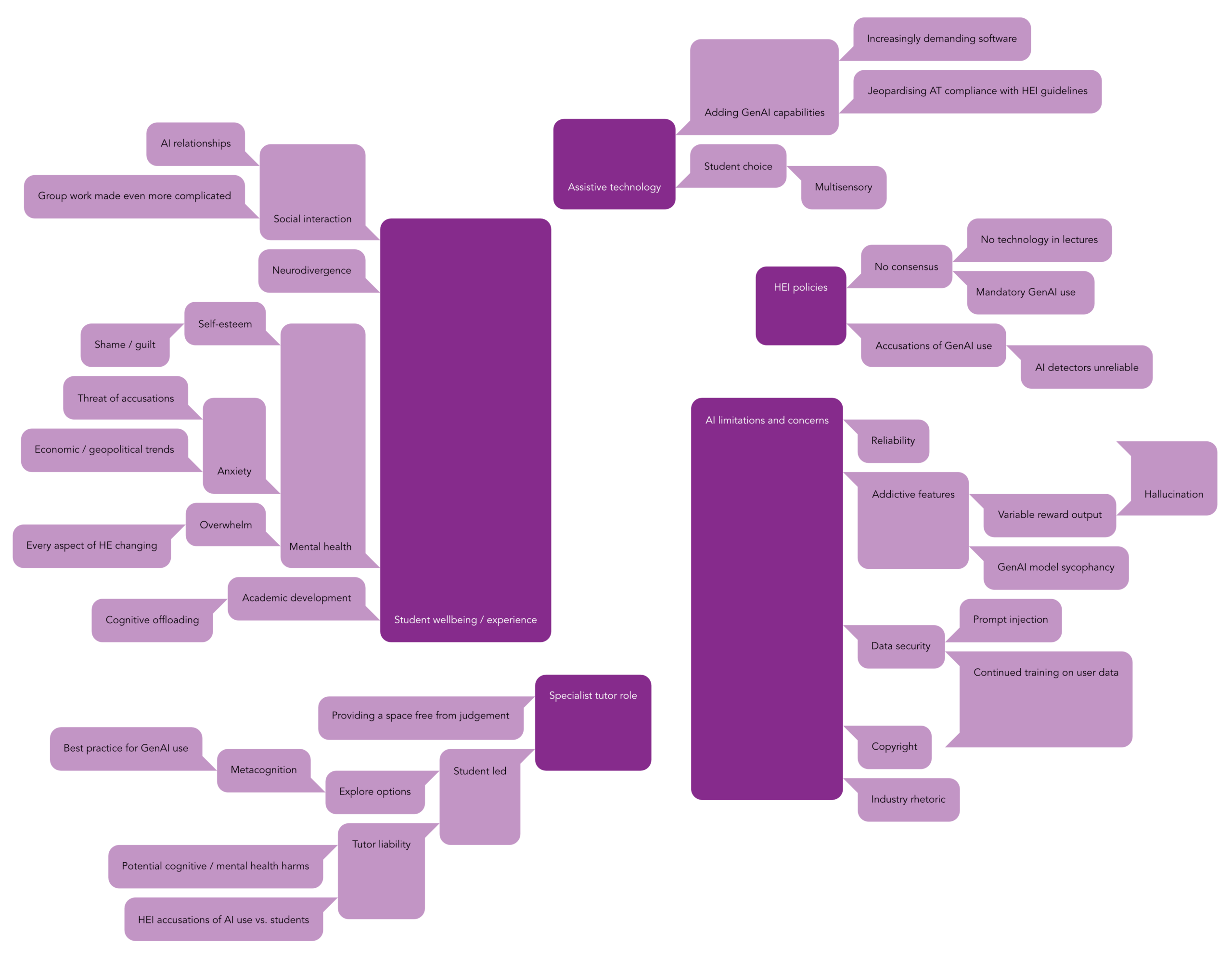
2.1 Specialist one-to-one tutors are best-positioned to be able to take a student-led approach to GenAI in a safe and confidential environment.

2.2 Given the wide range of institutional approaches, courses, disciplinary demands and GenAI products, it is likely that, for the foreseeable future, we will need to adopt a largely case-by-case approach to determining appropriate uses of GenAI.

This is particularly true for tutors who work across a wide range of institutions.

2.3 It is essential that tutors and students understand and defer to the relevant policies and guidelines set out by individual institutions regarding appropriate use of GenAI in assessments, assignments and coursework.

Tutors should encourage and support their students to access and understand their individual institutional and course policies on the use of GenAI in assessments, assignments and coursework.

Individual assignment briefs now also regularly contain AI policies specific to the assignment and need to be checked in case they differ from wider institutional policies.

2.4 Tutors are further encouraged to provide feedback on any concerns or examples of best practice through relevant channels to institutions, professional networks and sector bodies.

2.5 Academic norms, standards and assessment formats are all shifting in response to GenAI. This reinforces the need for tutors to have a broad base of knowledge regarding the capabilities, benefits, limitations and risks of GenAI, thereby equipping tutors to advise, support and empower their students to make an informed decision on the responsible use of GenAI, as determined by their needs and situation.

Further information and support will be available on the PASSHE website.

2.6 It is not tenable for tutors to opt out of engagement with, and understanding of, this technology as it pertains to academic settings.

In keeping with the PASSHE Good Practice Guidelines (see 3.3 The Learning Context, and 4.4 Delivery of Specialist 1:1 Tutorials), tutors should be able to provide, or at least signpost students to, basic information regarding:

  1. General safe boundaries for constructive GenAI usage, especially regarding the negative cognitive effects of approaches that reduce student engagement with core academic and literacy skills.
  2. General copyright and intellectual property concerns around GenAI.
  3. General data protection concerns around GenAI.

This is especially the case for any tools that tutors may find themselves supporting their students to use in sessions.

Information regarding these areas of concern will be available on the PASSHE website.

↑ Back to contents

3. Supporting critical literacy

3.1 Tutors are well-positioned to assess the wider impact of GenAI on critical literacy. It is likely that an over-reliance on text summarisation and generation negatively impacts the development of communication, literacy, and critical thinking skills.

3.2 While our general position is that students should be encouraged and trusted to take responsibility for their own education, we can play a critical role in assessing and addressing any learning and literacy gaps that may arise as a result of over-reliance on GenAI in academic study.

3.3 Tutors must develop approaches to supporting students working with GenAI that build independent skills rather than undermine them. In particular, the PASSHE 7 Principles are a tried and tested foundation for effective specialist support.

3.4 Four of the PASSHE 7 Principles that we feel should be a key focus for tutors regarding the use of GenAI are Metacognition, Motivation, Multisensory, and Relevance:

  • Metacognition

GenAI usage challenges traditional concepts of authorship. It is therefore crucial that tutors support students to develop reflective strategies, helping them to maintain and develop their authentic voice and a sense of ownership regarding any outputs.

Metacognition is also crucial for designing one’s approach to working with GenAI on specific tasks and for assessing output relevance and accuracy.

  • Motivation

GenAI usage has enormous potential to contribute to pre-existing trends in education that emphasise outcomes and final products to the detriment of learning, creativity, and individuality. Tutors should be alert to the potential for GenAI usage to further detract from students’ creative self-discovery and in-depth engagement with their learning, which can then also lead to diminished student confidence in these areas.

  • Multisensory

See item 5.2 of this document.

  • Relevance

Tutors need to support students to explore whether GenAI tools are an appropriate medium on a case-by-case basis. This applies not only for the task at hand and the development of core academic skills, but also in relation to understanding their own needs, individuality, agency, and creative originality.

↑ Back to contents

4. Specific technologies

4.1 Tutors should be alert to the addition of new GenAI features (however optional they may be) to assistive software that did not previously include them. Technologies provided through the Disabled Students’ Allowance (DSA) and by universities themselves no longer carry any guarantee that they are appropriate for use in all assessments at all institutions.

If necessary, the GenAI components incorporated into some assistive software can be switched off. However, this may not satisfy students’ individual institutional, course, or assignment brief policies regarding the use of AI.

4.2 It is increasingly important for tutors to maintain a nuanced understanding of the different functions that even an individual piece of assistive software may now provide, and the potential for the introduction of GenAI technology to raise new ethical, proprietary, privacy, security, wellbeing, and academic issues.

4.3 At the same time, many functions once limited to specialist technologies are also becoming more widely available, accessible in mainstream products. While we can’t be experts in every aspect of provision, tutors now need to have a basic degree of digital literacy across a wide range of technologies (see also 1.3 and 2.6 of this document).

To bridge knowledge gaps regarding technological changes and developments, we encourage consultation with other professionals, such as assistive technologists and needs assessors, and through available Career Professional Development opportunities.

4.4 We do not support institutional approaches which seek to simplistically permit or prohibit certain tools. It is challenging to keep up to date with the landscape of assistive technologies and AI products, and, as the range of features embedded in individual pieces of assistive software continues to grow, efforts to police the use of GenAI are of increasingly questionable value.

4.5 Nor do we support the institutional use of “AI detection” tools, which are currently built on fundamentally faulty premises.

Where AI use is entirely prohibited in assessments, the assumption is that a controlled environment is the only way to guarantee this.

4.6 For similar reasons, we do not condone attempts at identifying student usage of GenAI through specific vocabulary or punctuation by either lecturers or tutors. This approach has already been shown to disproportionately and inaccurately target the writing styles of neurodivergent students.

4.7 Tutors should be conscientious in neither policing nor promoting student use of GenAI tools on principle, focusing instead on fostering student agency and supporting progress in their literacy and study goals.

4.8 While taking note of GenAI additions to assistive software, tutors and institutions also need to be careful when identifying software as “AI”, a term not synonymous with either machine learning or automation but often mistaken for both.

For example, dictation, narration, and transcription software have long made use of machine learning in the processes used to construct them, and as such may increasingly be marketed as “AI-powered” despite having no interactive or generative capabilities.

4.9 While the companies providing machine learning-derived dictation, narration, and transcription software have not traditionally taken users’ input to further develop their technology, software containing GenAI chatbots is continuously trained on users’ input – including any personal information it contains – as standard and often by default without clear disclosure.

Tutors and students should assume that the private contents of their interactions with GenAI are not confidential unless clearly stated by the company providing the tool.

The specific approach to user data taken by different companies in the provision of these new GenAI capabilities is also addressed in item 6.2 of this document.

↑ Back to contents

5. Diversity of student profiles and needs and celebrating difference

5.1 Genuine student autonomy should include the option to meaningfully explore alternatives and avoid simplistic “one size fits all” recommendations regarding assistive technology provision generally and use of GenAI in particular.

5.2 Neurodivergent and disabled students have diverse profiles and needs. Current best practice is based on the recognition that access to a wide range of personal and technological supports is beneficial. Over-reliance on a single medium or approach to academic work is not recommended, corresponding to the commitment of specialist study skills tutors to a multisensory (PASSHE 7 Principles) approach in working towards student autonomy.

5.3 GenAI and other technologies are increasingly being explored as a positive force for accessibility. However, they can also contribute to creating new and unexpected barriers, gaps, or digital divides, that tutors must be aware of.

See also items 5.6 and 6.5 of this document.

5.4 The dynamic landscape of GenAI technology and potential emergence of new and complicated forms of digital divide mean that it is important for all students to be able to access and explore as many forms of support as possible, including those revolving around GenAI tools, with appropriate training. In light of this, tutors need to be sensitive to changes in the landscape of available technologies, and acknowledge that access to these is increasingly uneven, opening up new sources of inequality and exclusivity.

Although availability, affordability, and efficiency are all essential considerations of any study skills support package, they should not override student preference. Where possible, tutors should be working to support their students to access technology and strategies that enhance the student’s individual approach to learning and literacy, rather than just helping them to work with the provision available.

Students should be supported to make the right choices for them, according to their support package, the availability of alternatives, the policies in place on their courses, and their individual situation and educational needs.

5.5 Just as it is untenable for tutors to completely ignore the diversity of assistive technology available for supporting students to develop their literacy, learning, creativity, and autonomy, it is important to affirm that no assistive technology is adequate replacement for personal specialist support.

5.6 It is emerging that GenAI usage in the development of writing skills has a strong tendency to homogenise student writing styles and reduce creative choices.

Moreover, minoritised voices are underrepresented and stereotyped in the training data and GenAI outputs will reflect these biases, often in ways that are not immediately obvious, further obscuring these voices.

Tutors can support students’ self-expression, creativity, and ownership of their work by scaffolding reflective strategies and foregrounding students’ agency in decision-making.

↑ Back to contents

6.1 Tutors are well-placed to constructively explore GenAI use, provided that we exercise due caution and diligence, taking responsibility for output when, for example, generating teaching materials.

6.2 The broad data protection, copyright, and legal implications of GenAI are complex and changing rapidly. It is relevant that there are widespread legal concerns in relation to past and ongoing infringements of intellectual property in the creation of GenAI technologies and services.

Regarding these complexities, there is currently no consensus over the use of GenAI in academic settings.

6.3 We therefore advise caution and compliance in the interpretation of any existing workplace guidelines relevant to tutors’ individual circumstances, and respect for institutional guidance around the use of intellectual property and personal data.

In accordance with this, we should also support students who are using GenAI tools to avoid infringement of both institutional materials (e.g. lecture slides or recordings) and published materials (e.g. textbooks, journal articles).

6.4 Furthermore, our current position is that we must not use GenAI tools directly with any sensitive student data.

6.5 Where students or tutors wish to record appointments or use AI notetakers, both parties should be fully informed and consent documented.

There are a range of different types of AI transcription service on the market, some now incorporating GenAI capabilities and making use of user input to further train their models. These capabilities and activities are not always clearly disclosed, and tutors should not assume that all such products work the same way with respect to our data.

6.6 The exact legal details of the various possible uses of GenAI across various available tools, as well as their various approaches to intellectual property and data collection, are inevitably hard to summarise, but tutors can at least take steps to encourage more focused, limited, and intentional usage by making use of metacognitive principles (PASSHE 7 Principles, see item 3.4 of this document). Additionally, this can help to keep the locus of control with the student, supporting student agency and development, making for a more positive educational outcome.

6.7 Tutors should also be conscious of potential future liability regarding any stance taken concerning either the promotion or discouragement of GenAI use by students.

Rather than leading the choice on any preferred strategies and software, asking students what their preferred approach may be and supporting them to explore a range of options through metacognitive questions ensures that any approach taken is the student’s choice and responsibility, in line with the PASSHE 7 Principles (see item 3.4 of this document).

Tutors can best navigate this topic through adherence to:

  • The PASSHE Good Practice Guidelines (2.4 Metacognitive Development for Learning): ‘Specialist strategies need to be woven into the academic work that the student needs to produce. Sessions should start with some targets for the meeting and end with a recap of what’s been covered as well as agreeing what’s on the agenda for the next session. As the sessions are meant to be student-led, this type of goal setting has to be flexible to meet the demands of the student’s deadlines and priorities.’
  • And the PASSHE Student Charter, which states that students can expect ‘to receive student-centred support which is sensitive to [their] individual study needs and academic priorities’ and emphasising to students that ‘1:1 sessions are a safe, confidential environment in which they can access support and advice regarding the academic standards and requirements of their course’ (see also items 2.1 and 4.4 of this document).

6.8 As with other areas, PASSHE has a role to play in collecting and sharing resources or best practices.

Resources regarding best practice in the use of GenAI tools will be accessible on the PASSHE website in the near future.

6.9 We reiterate that this is a rapidly developing area and suggest that institutions, professional networks, and sector bodies must all play a role in calling for technology companies and governments to communicate clearly how they will address data protection, copyright, legal, and safeguarding concerns.

↑ Back to contents

Original Authors (November 2025 – June 2026)
  • Richard Fletcher
  • Tom Nash
Additional Contributors
  • Tahseen Haroon-Rashid
  • Diana Higgins
  • Dionysios Kyropoulos
  • Ruth Owen
  • Ola Podsiadlik
  • Julie Ross
  • Cheri Shone

Mindfulness, Mental Health,

and Successful Learning


The mental health of students in higher education is increasingly of concern to
specialist tutors. This online CPD course offers a brief outline of some of the ways
that poor mental health affects learning and suggests how developing mindfulness
practice with your students can build their resilience.  Mindfulness helps students
with strategies to overcome adversity and develop perseverance; it builds self-
knowledge and self-esteem to help towards a proactive attitude that learns.  You will
be invited to take part in mindfulness exercises and consider a range of mindfulness
and specialist study support strategies that will help you help your students.
This course is presented by Karisa Krcmar. Karisa is QA Officer for PASSHE and
headed up a team of specialist tutors at Loughborough University. She developed
mindfulness for study workshops with Tina Horsman and they later produced a book
Mindfulness for Study based on their programme. Karisa has since edited two more
books: The Inclusivity Gap about inclusive learning and teaching in higher education
and Helping Penguins to Swim which highlights a range of innovative practice
already happening in HE to help build resilience and good mental health among
students.
This course counts as 1-hour of PASSHE Accredited CPD.

Metacognition


Arguably, the driving force behind all learning. It is one of the most important of the
PASSHE 7-Principles®. This course will cover the basics of metacognition, the
theory as well as how it applied to Specialist one-to-one Study Skills and support
sessions. The course includes a step by step explanation and history of Flavell’s
theory. It goes on to discuss the guiding principles of the theory in practice. This
course is a starting point for your learning and contains material for you to follow up.
This course is presented by Elaine Doffman. Elaine is a Training and Development
Officer on the PASSHE Exec, and is a joint Regional Coordinator. She has been a
Study Skills Tutor for 16 years, working all over the country via distance support and
locally in the North West. Previously to tutoring, she was a teacher for many years
and qualified to teach people with dyslexia 30 years ago. She loves teaching and
tutoring, as well as producing resources and teaching materials.
This course counts as 1-hour of PASSHE Accredited CPD.

Cognitive Load Theory


This is one of the most important theories for us to consider in our one-to-one tuition.
It comes into almost everything we do and a great many of the strategies that we use
are based on it. This course will examine Sweller’s Cognitive Load Theory and
propose a Cognitive Load for Tutors model. Sweller proposed that working memory
is small and finite; he said that the way material is presented to students puts
considerable unnecessary load on the working memory. This course looks at the
theoretic factors he has proposed over the last 30 years, and goes on to examine the
biological and environmental factors that unnecessarily impinge on working memory.
As most students we work with have a smaller working memory, it is vital that we
remove these extraneous factors to allow the student to work at their best.
This course is presented by Elaine Doffman. Elaine is a Training and Development
Officer on the PASSHE Exec, and is a joint Regional Coordinator. She has been a
Study Skills Tutor for 16 years, working all over the country via distance support and
locally in the North West. Previously to tutoring, she was a teacher for many years
and qualified to teach people with dyslexia 30 years ago. She loves teaching and
tutoring, as well as producing resources and teaching materials.
This course counts as 1-hour of PASSHE Accredited CPD.

Building Students’ Confidence


This course is designed to build students’ academic confidence. Having self-
confidence is vital for academic success, and all too often students lack this. Building
a student’s confidence is a large part of our work. This course will give you ideas on
how to redress the problem of lack of confidence. As well as some practical ideas, it
is designed to act as a starting point for you to look into other theories to improve
your practice.
This course is presented by Elaine Doffman. Elaine is a Training and Development
Officer on the PASSHE Exec, and is a joint Regional Coordinator. She has been a
Study Skills Tutor for 16 years, working all over the country via distance support and
locally in the North West. Previously to tutoring, she was a teacher for many years
and qualified to teach people with dyslexia 30 years ago. She loves teaching and
tutoring, as well as producing resources and teaching materials.
This course counts as 1-hour of PASSHE Accredited CPD.

Blurry Borders: Mentoring Tips

for Specialist Tutors


This online course introduces a range of skills which support and give confidence to
specialist tutors as they work with the, often complex, needs of their students.  It
does not propose to offer training that would equip someone to become a mentor; it
aims, instead, to examine the role of a study skills tutor which encompasses some of
the basic tenets of mentoring which would fit within the boundaries of a study skills
session.

The course is written by Anne Betteridge, who has been an PASSHE member for
many years, and is presented by Karisa Krcmar. Karisa is QA Officer for PASSHE
and headed up a team of specialist tutors at Loughborough University.

This course counts as 1-hour of PASSHE Accredited CPD.

Kate Connery

Kate has an MSc from Queens University, Belfast, a PGDip in SpLD FE/HE from Edgehill University and qualifications in Adult Literacy and TESOL. After working for many years as a Careers Adviser she moved into Higher Education, working as an Education Adviser at Sheffield Hallam University and the University of Liverpool where she was responsible for inclusivity and internationalisation of the curriculum. Working with individual students she became increasingly interested in overcoming barriers to learning and became a qualified dyslexia teacher and assessor. Kate retired from her role as Specialist Support Tutor at the University of Sheffield in 2023 but continues to support students in a freelance basis. She has also worked as a TESOL teacher in HE and once owned a campsite in France. 

Tanya Zybutz

Tanya was there at the beginning when ADSHE was founded and has been part of the Executive for many years, designing and implementing the QA process with Janet Skinner and has been involved with all the working parties that devised and updated the PASSHE 7 Principles and our Profession’s Handbook. She has recently just finished working with Karisa Krcmar and Stella Klein on updating the PASSHE Handbook for 2025. Tanya has worked in the sector at a variety of HEIs most recently with The Royal Central School of Speech & Drama for over 20 years. Tanya currently works with ND academic staff and PhD students at Central.

Emily Adams

Emily Adams has been supporting students at the University of Hull for over 17 years, focussing on improving student success, experience, engagement, and support. She is employed as an SpLD Tutor, following study on ADSHE’s Level 5 qualification to become an ADSHE Quality Assured Specialist SpLD Tutor and she gained Accredited Tutor Status (ATS FE/HE) of the British Dyslexia Association (BDA) in 2022. She previously achieved Fellowship of the Higher Education Academy (FHEA) through her work around student experience and engagement. Prior to joining PASSHE in 2020, she held the position of Communications Coordinator and Executive Committee member of the UK Advising and Tutoring group (UKAT), 2014-16. Emily also represented the UK on the Global Initiatives Committee (GIC) for the Global Community of Academic Advising (NACADA), 2015-17. She has contributed to the Journal of Neurodivergent Learning and Teaching (2022), and has recently served as a Governor for a local primary school. Emily has an active interest in supporting and advocating for neurodivergence, and developing peer communities within higher education. She co-ordinates a Neurodivergent Staff Network providing peer support and advice, as well as facilitating an SpLD Community and other group opportunities for students. As Institutional Membership and Accreditation Officer, Emily is exploring a package to enable PASSHE to offer Institutional Memberships, promoting the role of Tutors and expanding the reach of PASSHE. Alongside this, she is developing a self assessment framework for HEI’s to evaluate, promote, and increase their provision for Neurodivergent Students across the full Student Experience, and possibility to gain PASSHE accreditation or high standards of provision.

Dr Dionysios Kyropoulos FHEA

Dionysios is a professional coach and trainer specialising in ADHD. He is a Fellow of the Higher Education Academy (FHEA) and holds the European Mentoring & Coaching Council (EMCC) Global Individual Accreditation (EIA) at Practitioner level. Before training as a coach, he developed a diverse portfolio career spanning performance, stage direction, teaching and research, with graduate studies at Cambridge and Oxford and a research fellowship at Harvard. Dionysios is an experienced educator with over 15 years of experience training individuals from aspiring professionals to established experts across diverse academic and professional contexts. For seven years he was Professor of Historical Performance and Academic Studies at the Guildhall School of Music & Drama, and has taught courses and workshops at institutions including Newcastle University, Shenandoah University, the University of Oxford, the University of Cambridge, the University of Burgos, City University London and Shanghai Jiao Tong University. Alongside his coaching and teaching practice, he serves as Co-Chair and Director of PASSHE and leads the organisation’s coaching training programme. For more information visit: www.kyropoulos.com

Kassandra Clemens

Kassandra Clemens is a transformational coach, trainer and educator with deep experience in working with neurodivergent professionals. She is autistic, dyslexic, dyspraxic and attention-different, and brings a rich, lived understanding to her teaching. A Level 7-qualified Specific Learning Differences Specialist and trained transformational coach, her work focuses on supporting neurodivergent adults to overcome psychological blocks and build confidence in their own judgement. With 19 years of experience supporting neurodivergent adults, Kassandra works at the intersection of trauma-aware practice and coaching. She is the founder and executive director of Heal Your Confidence Community Interest Company, where she integrates her knowledge of the nervous system and adult neurodevelopment into her coaching framework. She hosts monthly events exploring the lived experience of neurodivergence, and her approach is strengths-based, reflective and highly attuned to the needs of clients who struggle with self-doubt, inner criticism and fear of failure.

Jill Harris

Jill is an experienced Chartered Accountant and Fellow of the Higher Education Academy (FHEA). She worked in audit for a Big Four firm and in finance within the oil and gas industry prior to following her passion and moving to work in higher and professional education.

Cheri Shone

Cheri has been a PASSHE member since she first qualified as a Specialist Support Tutor. She deeply committed to developing her own understanding of neurodivergence and raising the awareness of neurodivergence based on that understanding. Cheri herself is Dyslexic. Her particular interest is how to navigate the intersections of the neurodivergent profile by centring and supporting the neurodivergent person themselves to develop this insight. Cheri has engaged with this work herself in both a personal and professional capacity. Her professional interest is focused on how to create a tutorial space that will facilitate this exploration. To that end Cheri has developed the VLR® Model that creates an effective scaffolding for that exploration and is the basis for the work she loves.

Stella Klein

Stella joined the Executive in 2020 with an interest in promoting and sharing innovative professional practice across its membership.
A PASSHE member and SpLD Tutor in Higher Education since 2007, Stella has provided individual and group support to students with SpLDs and other neuro-differences at several London universities including UCL, SOAS, Kings, Birkbeck, Central School of Speech and Drama. In addition to her freelance SpLD tutoring, she also continues to work in this role at Central St Martins, University of the Arts, London. With a background in Linguistics (BA), Education (PGCE, PGDip in Specialist Education) and Creative Writing (MA), Stella loves learning and developing her practice with her students, creating individualised tools for language development, critical reflection and writing from Foundation to PhD level. She is an Advance HE fellow, and has contributed to the Journal of Neurodiversity in Higher Education as well as to the Resources for Professional Practice section of the PASSHE website.

Bob Burwell

Bob is Specific Learning Differences Tutor who has been working at the University of Hull for the last 12 years. Bob has 25 years’ experience in Further and Higher Education. He has been an active member of ADSHE since 2008 and was PASSHE NE Regional Coordinator for 4 Years.  He has a Post Graduate Diploma in Dyslexia and Literacy, and a MA in Education, specialising in inclusion and assessment.  He also has been a teacher for many years with a PGCE. Bob’s particular interests are working with academic departments to develop inclusive curriculum practice. Bob is also keen on developing and protecting professional standards.

Diane de Villiers

Diana joined PASSHE when she started working in HE in 2008. As she has worked as a freelancer for a number of years, Diana feels passionately about endorsing the role of the freelancer and took up the PASSHE role of Freelance Officer in 2018. The role of the freelancer in this sector has become more demanding, providing opportunities as well as challenges. Diana came from teaching into SpLD support. She is a Specialist Teacher Assessor and Director of a company providing NMH support to students. In addition, Diana works as a Dyslexia Advisor at the University for the Creative Arts.

Kris Grainger

Kris Grainger is a Specialist Study Skills Tutor based in Staffordshire. Holding a BA (Hons) in Film and an MA in New Media Technologies, he has engaged in research within the audio and film industries, collaborating with renowned companies such as Lucasfilm, Pixar, and Dolby. A lifelong enthusiast of audio, Kris runs his own small studio, where he produces his personal podcast, as well as offering podcast production and professional audio services to various health and educational organisations. With a PGCE (FE/HE) and over 25 years of teaching experience across the FE, HE, and Adult Learning sectors, Kris is a dedicated advocate for inclusivity and support for students with Specific Learning Difficulties (SpLDs). In 2024, he completed the PASSHE Level 5 Course in Teaching Students with SpLDs in Further and Higher Education. Outside of his professional work, Kris is a passionate bass player and musician, with a particular interest in vintage synthesizers, many of which he uses to create jingles for his podcasts.

Jackie Hatfield

Jackie has been supporting neurodivergent students, in a one-to-one setting, at Loughborough University for 14 years. In this role, she engages with students ranging from those beginning their learning journey in Higher Education through to those pursuing the challenges of researching and writing their PhDs. Jackie supports neurodivergent students from across the range of disciplines at Loughborough. This experience has made her aware of the frustrations they encounter with academic writing. As a predominately visual learner she has become increasingly interested in investigating visual and creative strategies. This journey has led Jackie to discover Lego Serious Play, and prompted her to become a trained facilitator of Lego Serious Play methodology, to support her neurodivergent students (and potentially the wider student population) to reach their potential in a text heavy environment. In 2015, Jackie became one of the Regional Coordinators for the Midlands Regional Group, along with her Loughborough colleague, Tina Horsman. In September 2019, she became the Regional Officer of PASSHE.

Dr Dylan Griffiths

Dylan offers almost 20 years of experience supporting neurodivergent individuals in education and the workplace, with expertise in dyslexia, dyspraxia, dyscalculia, ADHD, autism, and physical or sensory impairments.

He provides two core services: neurodiversity screenings and needs assessments. Screenings explore indicators of specific learning differences and neurodivergent profiles, offering a cost-effective way to better understand individual needs without the commitment of a full diagnostic assessment. Needs assessments provide tailored, practical recommendations - ranging from assistive technology and one-to-one support to team awareness training and low- or no-cost adjustments. All strategies are person-centred, sustainable, and aligned with organisational goals.

Dylan's approach is grounded in both academic and professional expertise, drawing on his mathematics PhD, specialist qualifications in Dyslexia and Dyspraxia, and role as a certified Mental Health First Aid Champion. He also contributes to national policy and practice as co-chair of PASSHE and a board member of SASC, shaping standards in assessment and support.

Dr Dylan Griffiths

Dylan has been supporting neurodiverse students and staff since 2006, offering one-to-one support sessions, neurodiversity screenings, and needs assessments. Over the years, his roles have spanned across higher education, the full DSA system, and the workplace, giving him a broad understanding of how best to provide effective support in different settings.

His specialist area is numeracy, but he also brings a strong focus on integrating Study Skills with Assistive Technology. As a keen advocate of technology, Dylan believes that the right tools can make studying and working not only more effective, but also more empowering. His sessions are designed to build confidence, encourage independent learning, and help people work smarter and more efficiently.

Irina Staneva

Irina brings extensive experience of leading multidisciplinary services across disability, wellbeing, counselling and DSA-funded provision, with a strong focus on inclusive practice and strategic service development. She has held senior leadership roles in both higher and further education, leading complex safeguarding and Student of Concern processes, strengthening reasonable adjustments systems to improve access, and embedding preventative mental health within institutional strategy. Irina previously managed a regional DSA Assessment Centre and has contributed to sector policy and practice through representation at the Disabled Students’ Stakeholder Group. Her work is underpinned by a commitment to equity, professional standards and evidence-informed improvement.

James Bramley

James leads digital development across PASSHE’s services, streamlining processes, managing complex information, and helping shape systems that support the organisation’s future growth. With a background in music, languages, and politics, he brings a broad interdisciplinary perspective. Alongside his role at PASSHE, he maintains a portfolio career as a freelance musician and inclusive music educator with the leading participation organisation Live Music Now.

Tony Smith

Tony started as a Senior IT Support Assistant at Cardiff Metropolitan University in 2009 before becoming their first Assistive Technology Trainer in 2010. In March 2011, Tony attended a five-day course Understanding SpLD and Strategies for Support. He met Sandra Hargreaves, who supported Tony’s application to attend London Metropolitan University and undertake the Post Graduate Certificate: Teaching Adult Dyslexic Learners in Higher and Further Education. In September 2011, Tony became the Specialist Study Skills Co-Ordinator and the only Tutor at Cardiff Metropolitan University, so he had no problem finding students for his teaching practice as he had over 100 students requiring support. In November 2011, Tony established a small team of Tutors who remained with him until his departure in 2020. He ensured meetings occurred once a term to share best practices and participate in CPD and Professional Peer Supervision (PPS)®. During the same period, Tony was a tutor on the PASSHE Level 5 course. However, he has decided to retire from supporting students. Still, being the eternal opportunist, he is not fading into the background but continues to support the profession now as Treasurer.

Fran Stanton

Fran has worked in Marketing and Recruitment roles at the University of North London and in the Business and Law Faculty at De Montfort University, Leicester.  In 2006 she became International Student Support Coordinator within the Student Support Office at University of York and subsequently, College Administrator at Halifax College, University of York.  On leaving York in 2015, she took up administrative roles within the Anglican Diocese of York and then the Catholic Diocese of Leeds.

Suzanne James

Suzanne is an experienced Administrator with a wide experience within the educational sector. Prior to joining PASSHE in 2018, she worked for the University of Reading Study Advice and Counselling services.  She has a background in corporate public relations and marketing.

Tina Horsman

Tina Horsman is a specialist tutor at Loughborough University, renowned for her expertise in supporting neurodiverse students. With over twenty years of experience in assessing and aiding students with specific learning differences (SpLDs), Tina has co-authored the book Mindfulness for Study: From Procrastination to Action, which provides valuable insights into applying mindfulness techniques to academic contexts. At Loughborough, Tina co-developed the "Mindfulness for Study Programme", designed to help students with SpLDs such as dyslexia and dyspraxia to manage stress and improve their study skills. This programme has received significant recognition for its positive impact on student performance and well-being. Tina's recent work includes the publication of the article "Navigating the Essay: Making Writing Multi-Sensory", which explores innovative methods to enhance students' writing processes by incorporating multisensory approaches. A long-time member of PASSHE, Tina became a Director in March 2024.

Dr Karisa Krčmář

Karisa has an MBA from Glasgow, an MEd and PhD from Birmingham.  After working in a variety of commercial sectors ranging from shipping to ballet, she changed direction, went into teaching adults and became fascinated with why learners don’t learn.  She undertook dyslexia teaching and assessor training, followed by CPD focussing on ADHD and Mental Health and became a Specialist Tutor at Loughborough University. Karisa is a Mindfulness practitioner, and with one of her colleagues, developed and ran mindfulness workshops culminating in the publishing of Mindfulness for Study: from procrastination to action.  She was the first editor of the Journal of Neurodiversity in Higher Education (ADSHE) and has edited books about inclusive learning and teaching (The Inclusivity Gap) and successful projects for building students’ mental health resilience (Helping Penguins to Swim).  Karisa is a Senior Fellow of the Higher Education Academy and has a black belt in Shotokan Karate.